
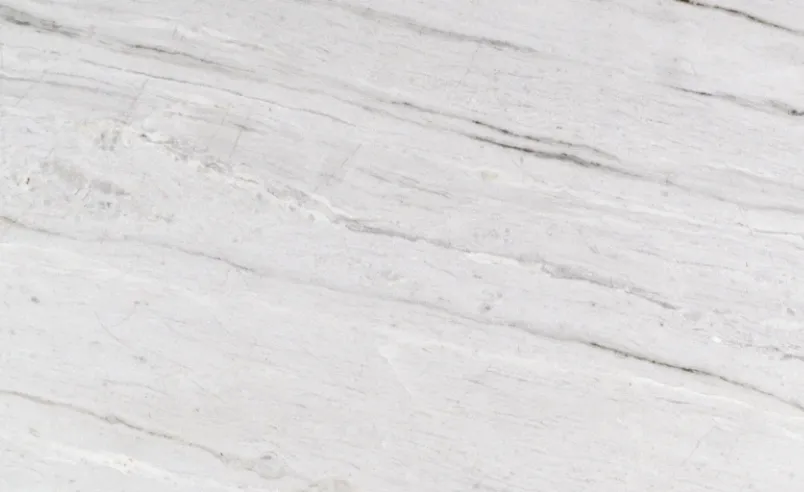
The Holy Grail
For 50 years, homeowners faced a choice: The beauty of White Marble (fragile) OR the durability of Granite (speckled/busy).
Then came Taj Mahal Quartzite. It changed the industry.
The Geology
Despite the name, it is not from Agra. It is a natural Quartzite quarried in Brazil. It was once sandstone, but volcanic heat fused the grains into solid quartz crystal.
Hardness: Mohs 7-8. It is harder than steel. You cannot scratch it with a knife.
Acid Resistance: Unlike marble, it does not contain calcium. Lemon juice, vinegar, and wine will not etch it.
The Aesthetic
It features a soft creamy/white background with subtle waves of gold, amber, and grey. It has a translucency (depth) that granite lacks. It mimics the look of Calacatta Gold marble perfectly.
The Cons (Price & Fabrication)
1. Material Cost: It is expensive. Expect to pay $100-$150 per sqft.
2. Fabrication Cost: It is too hard. It eats diamond blades. Fabricators charge a premium to cut it because it takes 3x longer than granite.
3. Fakes: Beware of "Soft Quartzite" (actually Dolomite). Always do the Glass Scratch Test.
Verdict
If budget allows, Taj Mahal is the perfect countertop material. It offers the zero-maintenance of granite with the high-end look of marble.